


PEPs: Are They a Better Fit for Your Business Than a Traditional 401(k)?
When it comes to administering a 401k, it can often feel overwhelming for business owners. The rules, duties and responsibilities are complex. As a retirement plan fiduciary, you must:
Act for the exclusive purpose of providing benefits to participants and beneficiaries
Evaluate the reasonableness of fees paid by the plan
Act with care, skill, prudence, and diligence
Seek professional advice if you do not have experience in a particular area
Diversify the plan’s investments
Operate in accordance with the plan documents and instruments governing the plan
A survey of small businesses1 found that a lack of resources is one of the top impediments to offering a retirement plan. Smaller businesses typically don’t have the time, technology, or infrastructure needed for the day-to-day management of a plan. With a PEP, administration and reporting are handled by a registered Pooled Plan Provider (PPP), freeing employers to focus on their core business.
So what is a Pooled Employer Plan (PEP)? And what role can it play in helping business owners streamline administration of these requirements?
A PEP is a type of Multiple Employer Plan (MEP), a corporate retirement plan allowing multiple unrelated employers to participate.2 PEPs entered the marketplace in 2021 through SECURE Act as Congress sought to encourage more employers to offer a workplace retirement plan.
Specifically, a PEP is a new kind of defined contribution plan arrangement that is treated as a single plan, files a single 5500, undergoes a single audit, and transfers most fiduciary and operational duties to a Pooled Plan Provider (PPP).
So, what are some differences between Stand-Alone 401(k) plans, MEPs and PEPs?
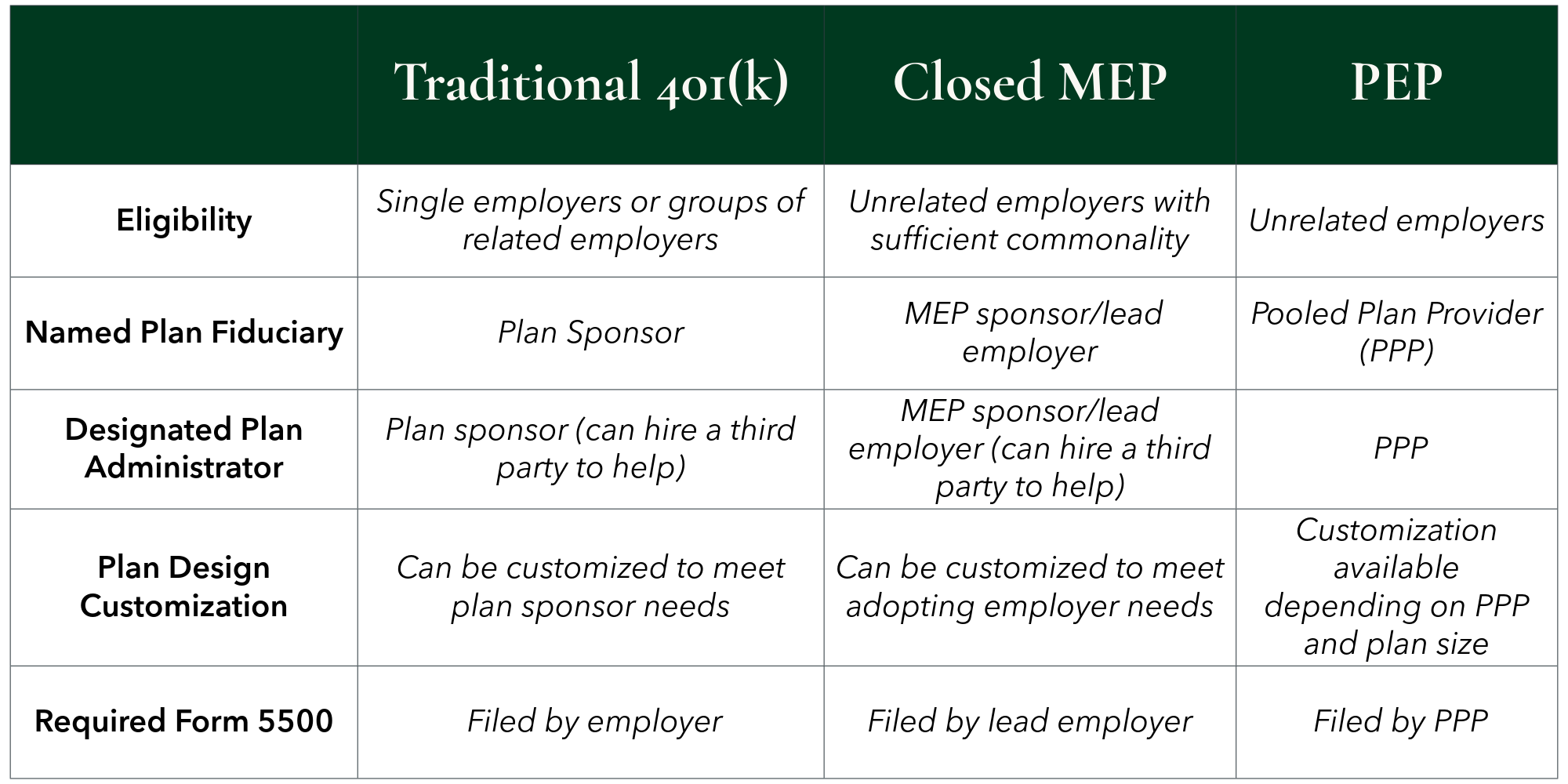
While no plan structure can eliminate all fiduciary responsibilities, PEPs offer a way to shift many of these duties to a PPP. The ability to offload risk has become more important as litigation over excessive fees and other actions has grown in recent years.
Additionally, because of scale, PEPs may be able to provide access to lower-fee investment options. Lower fees can translate into larger retirement account savings over time for participants.
To summarize, employers adopting a PEP are able to offload many complex aspects of running a retirement plan, allowing for greater focus on their core business.
Questions? Contact our office at (516) 222-0021 and ask for Michael Abate, AIF®, CRPS®, or learn more at our upcoming October 28th webinar:
1 Small Business Retirement: Investing in Your Future.” SCORE. December 20, 2022. https://www.score.org/resource/infographic/infographic-small-business-retirement-investing-your-future
2 2025 Pooled Employer Plan Bulletin | U.S. Department of Labor: https://www.dol.gov/agencies/ebsa/researchers/statistics/retirement-bulletins/pooled-employer-plan-bulletin/2025
United Asset Strategies believes that the content provided by third parties and/or linked content is reasonably reliable and does not contain untrue statements of material fact or materially misleading information. This third-party content may be dated.