


The Great (AI) Wealth Transfer
Today’s financial markets have solid fundamental underpinning, as seen in the impressive +25% earnings growth expected for the S&P 500 in 2026. Still, some of those fundamentals are starting to appear stretched, raising questions about the sustainability of the current exceptionally strong growth trajectory. As Exhibit 7 illustrates, the major hyperscale cloud providers - Amazon, Alphabet, Meta, Microsoft and Oracle - have delivered impressive earnings growth since the launch of ChatGPT in 2022.
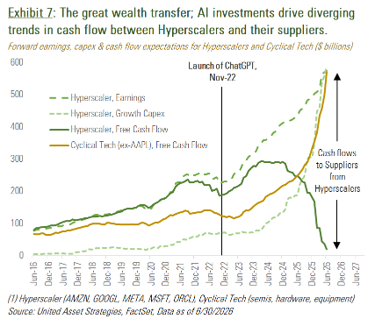
Still, their cash flows have not kept pace, peaking near $300 billion in 2025 and trending down toward break even since, owing to their ramping AI investments.
Indeed, amid this significant investment cycle, Hyperscalers’ growth capex has risen from $70 billion pre-ChatGPT to nearly $600 billion today. Historically capital-light businesses that converted nearly all profits into cash, the major Hyperscalers are currently less cash generative and are now seeing investors assign lower valuation multiples as a result - 19x earnings versus 24x to start the year.
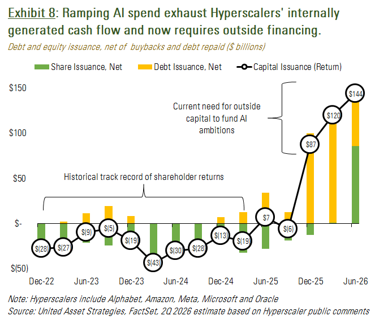
While Hyperscalers’ stocks have been flat to down this year, the stocks of their suppliers have benefited handsomely from this spend. As the exhibit also shows, cyclical areas within the technology sector - such as the semiconductors, equipment, and hardware industries - have seen cash flows rise alongside Hyperscaler capex, and their stocks more than double year-to-date as a result. With internal cash flows largely spoken for, however, the major Hyperscalers have increasingly turned to debt and equity markets to fund their AI data center projects.
As Exhibit 8 shows, this marks a shift from a historical track record of minimal debt and significant stock buybacks. This dynamic adds a new layer of complexity to the AI buildout and resulting market strength, as they are now more dependent on the willingness of markets to finance these ambitious AI builds.
Watch United's full July market commentary here.