


Consumer Resilience & Outsized AI Investment
Despite energy price fluctuations caused by the War in Iran - and the uncertainty added to an already complicated inflation picture - the consumer remains resilient, supported by tax refunds from the One Big Beautiful Bill Act (OBBBA) and a solid labor market. This is critical, as consumer spending accounts for roughly 68% of U.S. Gross Domestic Product (GDP). In addition, private fixed investment remains robust, driven by substantial investments by businesses in artificial intelligence (AI). Indeed, corporate and consumer spending are what we refer to as the core components of GDP and are contributing positively to growth.
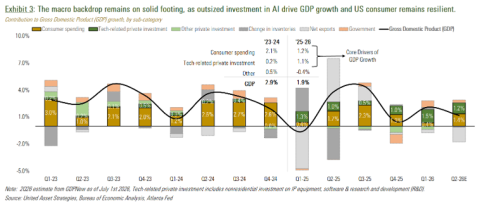
For example, as shown in Exhibit 3, tech-related categories within private fixed investment (such as information processing equipment, software, and research and development) added an outsized 1.1 percentage points (pp) on average to economic growth in 2025 and 2026 so far – nearly matching the 1.2pp contributed by the much larger U.S. consumer over that same time frame and substantially larger than the 0.2pp that tech spending contributed over the prior 2023-2024 period. Meanwhile, the remaining components of GDP, such as other private investments, inventories, net exports and government have recently been breakeven contributors at best.
As shown in Exhibit 4 via the Citi Economic Surprise Index, this macro strength has caught many economists by surprise. With positive readings indicating positive surprises, the index sits at ~50 - a historically strong level. The exhibit also shows a strong relationship between the economy and corporate profits, with S&P earnings estimates revised higher alongside a stronger economy. Strong earnings revisions have, in turn, supported solid stock market returns, particularly in technology companies benefiting from outsized AI spending.
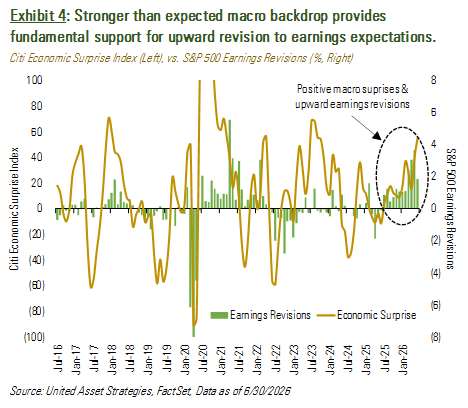
Looking ahead, we would note that absent an exogenous shock (e.g. Covid) the economy has rarely entered a recession without weak corporate earnings, a rising unemployment rate, or soft corporate capital expenditures (capex) - none of which exist today. Indeed, leading economic indicators point to continued strength. For example, the U.S. Manufacturing PMI Index has been in expansionary territory for each of the last 11 months.